
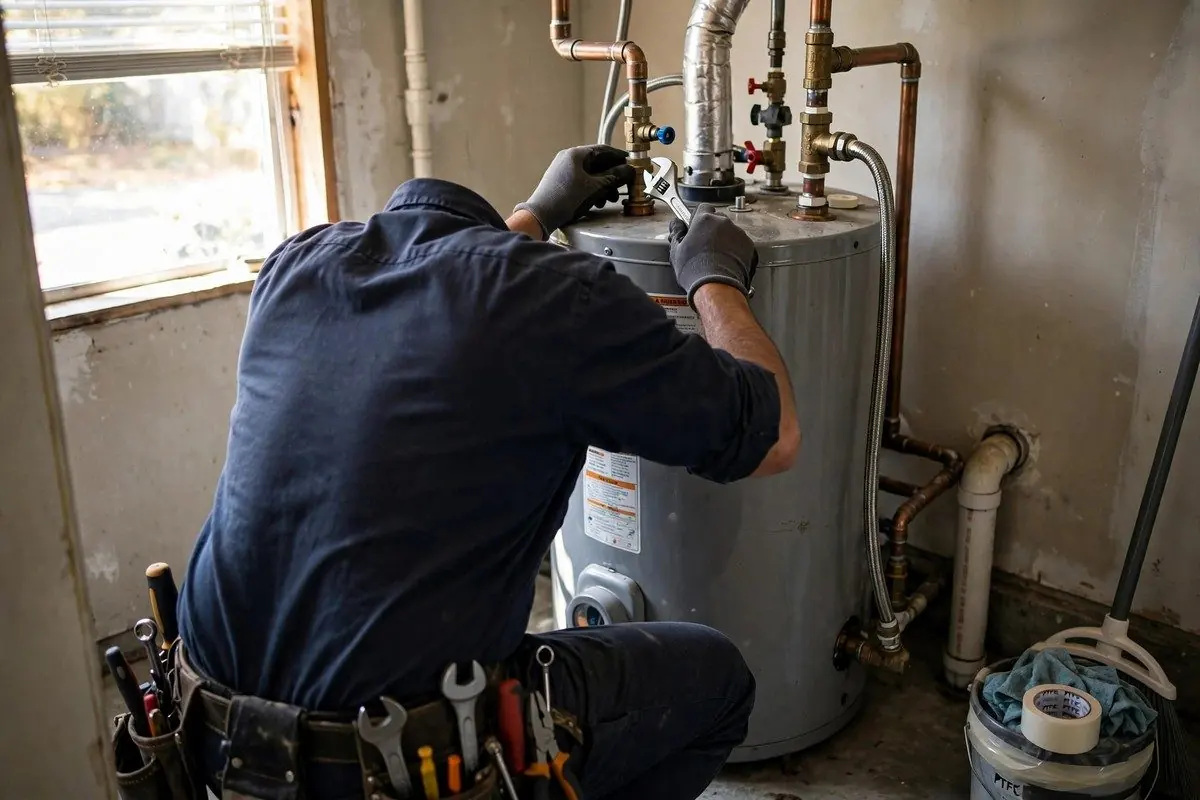
Emergency Water Heater Repair in Maple Shade, NJ
No hot water on a cold morning, or water spreading from the base of the tank? Call the 24/7 line and we will tell you what to shut off while a plumber is on the way.
No Hot Water: What to Check Before You Call
A dead water heater is an emergency when it leaks or when a household cannot go without hot water. Our emergency water heater repair line in Maple Shade is open 24/7, and we book same-day visits when we can. If water is pooling, close the cold-water valve on top of the tank and, for an electric unit, switch off its breaker.
Check the power or pilot
Electric units need a tripped breaker reset. Gas units need a lit pilot and the gas valve open.
Feel the pipes
A hot outlet pipe with no hot water at the tap points to a fixture or mixing valve.
Look at the base
Water around the tank can be a fitting, which is repairable, or a failed tank, which is not.
Note the data label
Brand, age and capacity let us arrive with the right parts.
Common Failures and What They Mean
| Symptom | Usual cause | Typical outcome |
|---|---|---|
| Lukewarm water, electric tank | Failed heating element or thermostat | Repair, parts are inexpensive relative to the tank |
| No heat, gas tank | Pilot, thermocouple or gas valve fault | Repair in one visit when the tank is sound |
| Water dripping from the tank base | Corroded tank shell | Replacement, see water heater replacement |
| Dripping from the relief valve line | Bad valve or high pressure or temperature | Valve replacement, check pressure and expansion tank |
| Rumbling or popping | Sediment baked onto the bottom | Flush, and if heavy, plan on replacement |
Most tanks last roughly 8 to 12 years. If yours is past 10 and leaking from the tank itself, repair is rarely worth the cost, and we will say so before quoting anything.
A Water Heater Leak Is Not Always the Tank
Leaks cause a large share of the water heater calls we see, and many of them come from fittings, not the tank. Supply connections, the relief valve, the drain valve and the anode port can all weep. Those are repairable, and finding the true source keeps a sound tank in service.
A tank that leaks from its shell has corroded through and cannot be patched. Water also reaches the floor from a nearby pipe or a condensation line, so we trace the water before we name the cause.
Water Heater Repair problem right now?
Call the 24/7 line. We book the next available visit and tell you what to do while you wait.
Maple Shade Water and Your Tank
The 2024 water quality report from Maple Shade Utilities says the township treats high iron in water from its wells before it reaches customers. Iron or any sediment that does arrive settles at the bottom of a tank, which is why an annual flush is worth doing. We do not state a hardness figure for Maple Shade because the report does not give one, and a simple test of your own tap is the better guide.
Many homes in town date from the 1960 to 1980 building boom, so original water heaters have often been replaced once already. When we open a utility closet in an apartment or older house, we also check venting, the relief valve line and the drain pan, since those age with the tank.
The same service is available in nearby towns, for example Moorestown and Mount Laurel, where larger homes may run two tanks.
Gas Versus Electric: Where Failures Differ
Gas and electric tanks fail in different places. On a gas unit, the thermocouple, pilot assembly, gas control valve and flue are the usual suspects. On an electric unit, the upper and lower heating elements and the thermostats fail far more often than the tank.
That difference matters for repair cost. Replacing one element on an electric tank is a modest job, while a failed gas control valve on an older tank may cost enough that replacement is the better value. We tell you where your unit falls before we quote.
If you smell gas near a gas tank, leave the building and call the gas utility or 911 first. Do not call us from inside the house.
Temperature, Scalding and Safety
Many safety guides suggest setting a tank to about 120 degrees Fahrenheit, which reduces scald risk, especially in homes with children or older adults. If your water is scalding or never gets hot, the thermostat or a mixing valve may be at fault. We check the set point and the actual output.
The temperature and pressure relief valve is a safety device. If it drips or discharges, treat it as a warning, not a nuisance. Never cap the discharge pipe.
What Affects the Price
A repair is priced by the part and the access, and we quote it before starting. Replacing an element is a different job from replacing a gas control valve.
Insurance note
A sudden tank rupture that damages floors or walls is sometimes covered, and a worn-out tank usually is not. Photograph the damage and ask your insurer.
Common Questions
Yes. The line is open 24/7, including weekends and holidays. A tank leaking onto a finished floor goes to the front of the line.
If the tank is leaking from the shell or is past about 10 to 12 years, replacement usually makes more sense. A failed element, thermostat or pilot assembly on a younger tank is a good repair.
It may be the drain valve, a connection or the tank itself. Dry the area and watch where the first drop forms, then call so we can confirm.
A broken dip tube, a failed element or a lot of sediment can cut the usable hot water. A plumber can test each one on a visit.
Many homeowners do, following the label on the unit. If you smell gas, leave the building and call the gas utility or 911 before you call us.
Many repairs finish in one visit when we have the part. We will tell you when a part has to be ordered.